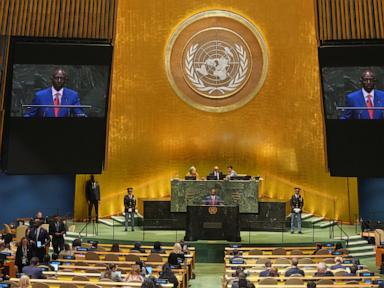
The United Nations was built for a world that no longer exists. Back in 1945, the architects of the post-war global order carved up planetary authority among a handful of victorious nations, locking in a hierarchy that has survived for nearly eight decades. Today, that arrangement looks less like a system of international security and more like an anachronism. African leaders have made it crystal clear that they are done waiting on the sidelines. They aren't just asking for a polite nod or symbolic inclusion anymore; they are demanding a permanent seat at the table of power.
If you look at the architecture of the UN Security Council, the imbalance is glaring. Fifteen nations hold the keys to international peace and security, but only five hold the absolute trump card: the veto. The United States, Russia, France, the United Kingdom, and China make up an exclusive club that dictates global interventions, sanctions, and crisis responses. Meanwhile, a continent of over 1.4 billion people with 54 member states shares just three rotating, non-permanent seats with zero veto power.
Kenyan President William Ruto put it bluntly during high-level debates at the UN General Assembly: every nation is sovereign and equal under the charter, yet on the gravest questions of war and peace, five nations possess a permanent power that the other 188 do not. The equality proclaimed in this assembly ends at the doors of the Security Council. It is a stark assessment, and honestly, it is hard to argue with.
The Weight of Historical Injustice
Liberia’s President Joseph Nyuma Boakai captured the frustration of many heads of state when he pointed out that this historical injustice is no longer tenable. When the foundational rules of the international system were written, most of Africa was still colonized. Those nations didn't have a voice because they didn't have statehood. Decades later, the geopolitical map has completely transformed, but the UN’s executive branch remains frozen in amber.
This isn't merely about hurt feelings or diplomatic vanity. The Security Council makes binding decisions that directly affect African soil, often without meaningful input from the people living through the consequences. From peacekeeping mandates in the Central African Republic and the Democratic Republic of Congo to economic fallout from European and Asian conflicts, African countries bear the brunt of global instability. Yet when the veto gets waved, continental priorities are routinely sidelined.
The argument for reform rests on institutional survival. An international organization that claims to represent global interests while completely excluding an entire continent from permanent leadership loses its legitimacy. As global crises multiply—ranging from runaway climate shocks to transnational security threats—the structural deficit of the UN becomes a liability. You cannot effectively manage twenty-first-century problems with a mid-twentieth-century committee.
The Unified Stand Behind the Ezulwini Consensus
Africa is not showing up to these negotiations without a plan. Two decades ago, the African Union crystallized its position through the Ezulwini Consensus, a unified diplomatic framework demanding at least two permanent seats with full veto powers for the continent, alongside an expanded rotation of non-permanent spots.
The core debate within this demand centers on power itself. African diplomats argue that accepting permanent seats without the veto would simply create a second-tier form of membership—a glorified observer status that leaves real authority concentrated in the same old hands. If you are going to seat new permanent members, they must possess the exact same tools to protect their regional interests as the legacy powers.
Yet, translating this unified stance into a concrete reality brings up internal challenges that analysts often whisper about. The African Union represents 54 distinct nations with divergent regional priorities, economic structures, and foreign policy alignments. Selecting which specific countries would occupy those proposed permanent seats remains a deeply sensitive diplomatic hurdle. Should the spots rotate among regional heavyweights? Should specific nations take permanent ownership? These questions test the limits of continental solidarity.
The Institutional Roadblocks Ahead
Even if the rest of the world agreed with Africa's demands tomorrow, changing the UN Charter is an uphill battle by design. Under Article 108, any structural amendment requires approval by two-thirds of the General Assembly and ratification by two-thirds of UN members, including all five permanent members of the Security Council.
Think about what that means. The five countries currently holding permanent veto power must formally vote to dilute their own monopoly. Asking a privileged club to hand out keys to the executive washroom is never easy. Past diplomatic maneuvering has seen various framework proposals stall out because incumbent powers prefer paralyzing deadlock over sharing authority.
Countries like Burkina Faso and Mali, speaking through the lens of the Sahel states, have repeatedly called out the double standards and institutionalized exploitation embedded in legacy international frameworks. They argue that the persistent lack of representation is tied to a broader pattern of external interference and economic marginalization. For these nations, Security Council reform is part of a wider reckoning with a neocolonial economic order that drains local wealth while dictating terms from foreign capitals.
What Needs to Happen Next
The push for a reformed Security Council is reaching a boiling point because the cost of inaction is too high. Trust in multilateral institutions is eroding fast. When regional conflicts erupt and the UN appears paralyzed by veto gridlock, confidence vanishes.
For African leadership, the strategy moving forward requires maintaining absolute discipline on the core demand—real permanent representation with veto rights—while navigating the intricate internal politics of who eventually sits in those chairs. It also means building cross-continental alliances with other unrepresented regions like Latin America and South Asia, creating a broader coalition for structural change.
The status quo benefits a shrinking minority of global powers who are increasingly out of touch with demographic and economic realities. The conversation has shifted from whether the UN Security Council needs a total overhaul to how long the current members can pretend the exclusion is sustainable. The demand from the continent is simple and entirely justified: equality at the global table is no longer negotiable.