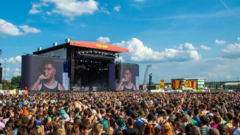
Large-scale outdoor entertainment operates under a fragile spatial contract. When Festival Republic applied to vary its licensing parameters for the Reading Festival to introduce an additional day of main stage performances running from 5 PM to midnight, the friction between commercial optimization and residential utility immediately intensified. Local municipal debates over expanded operating windows are rarely about sound alone. They represent a collision between economic output, regulatory compliance thresholds, and the acoustic carrying capacity of urban-adjacent green spaces. Deconstructing this friction requires analyzing the propagation mechanics, the licensing cost functions, and the stakeholder incentives that dictate festival logistics.
The Spatial Economics of Urban-Adjacent Events
The Richfield Avenue site sits in close proximity to residential zones, creating an inherent land-use conflict. Municipal event licensing attempts to balance commercial value generation against community displacement costs. Organizers target operational extensions to maximize yield per square meter of infrastructure, amortizing fixed capital costs—such as stage construction, security, and sanitation networks—over a longer revenue window.
For the surrounding community, particularly districts across the Thames like Caversham, an extra day of operation alters the local cost-benefit equilibrium. Residential associations such as the Warren and District Residents Association and the Caversham and District Residents Association have historically flagged that weekday extensions transform a weekend-contained disturbance into a mid-week operational hazard. The economic tradeoff is stark:
- Commercial Yield: Incremental ticket sales, expanded food and beverage capture, and higher sponsorship valuations.
- Externalized Costs: Sleep disruption, localized traffic congestion, municipal policing overhead, and accelerated wear on public infrastructure.
When operating hours expand into a working night, the tolerance threshold of the host community contracts sharply. The marginal utility of extra music hours for attendees must be weighed against the immediate spike in cortisol and sleep deprivation metrics for residents.
Acoustic Propagation and the Decibel Limit Fallacy
Public complaints regarding festival audio frequently center on the perceived failure of local enforcement. However, acoustic propagation outdoors is governed by environmental variables that fixed licensing limits struggle to capture. Sound emission is a function of source power, directivity, atmospheric absorption, and meteorological conditions.
[Main Stage Sound Source]
       │
       ▼ (Atmospheric & Meteorological Vector)
[Wind Shear & Temperature Inversion] ──> [Acoustic Energy Deflection]
       │
       ▼
[Residential Receptor (Caversham/Kentwood)] -> [Vibration & Extreme Noise Perception]
Event licenses typically stipulate maximum decibel thresholds measured at specific boundary locations, such as LeEQ 15-minute limits. Yet, compliance during performance hours does not eliminate disturbance. Low-frequency bass propagation travels significantly further through dense air and urban structures, often causing physical vibration well below the legal decibel threshold for mid-to-high frequencies.
Furthermore, meteorological factors dictate wave trajectory. Wind shear and temperature inversions can refract sound waves downward into residential zones miles away from the source. Organizers can fully comply with licensing instrumentation on-site while local receptors experience severe acoustic intrusion due to atmospheric lensing.
Regulatory Enforcement Bottlenecks
Municipal oversight relies on a reactive reporting loop. Residents register complaints with local authorities, who then log incidents for post-event reviews or communicate dynamic feedback to festival management. This mechanism introduces structural latency:
- Incident Generation: A headline set produces localized low-frequency spikes or wind-carried volume surges.
- Reporting Friction: Residents must log grievances via council channels, creating a time lag between acoustic emission and administrative registration.
- Remediation Delay: By the time field officers assess the vector, meteorological conditions have shifted or the performance has concluded.
This latency renders real-time mitigation ineffective. Feedback loops that operate on multi-week council meeting cycles fail to address immediate community friction. Consequently, trust erodes between municipal authorities, event organizers, and neighborhood groups, turning every license variation request into a proxy war over historical grievances.
Strategic Infrastructure Adjustments for Future Compliance
Resolving the structural tension between festival growth and community preservation requires moving beyond static decibel caps. Organizers must deploy dynamic acoustic governance models that account for environmental volatility.
Deploying phased array sound systems allows engineers to steer acoustic energy downward into the audience basin while creating destructive interference zones directed toward sensitive residential corridors. This technology shifts control from reactive volume reduction to active directional containment.
Simultaneously, license structures must tie operational extensions to automated real-time telemetry. By deploying continuous, open-access noise monitoring arrays linked directly to an automated dashboard shared by the council and organizers, the latency of the complaint-response loop is eliminated. If sound pressure levels breach dynamic limits adjusted for wind speed and direction, automated power throttling at the mixing console enforces compliance before municipal intervention becomes necessary.
Sustainable festival expansion hinges on internalizing environmental externalities. Until acoustic engineering solutions match the scale of modern line arrays, municipal friction will remain the primary bottleneck for live entertainment growth.