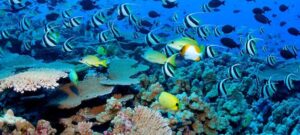
People usually think of the United Arab Emirates as a place of soaring skyscrapers, massive desert dunes, and oil wealth. They rarely look below the waterline of the Arabian Gulf. That's a mistake. The waters off the coast of Abu Dhabi are currently home to a massive environmental reclamation project that is breaking global records.
The Environment Agency – Abu Dhabi (EAD) recently announced it cultivated 302,415 new coral colonies in the first half of 2026 alone. This pushes the total number of cultivated corals under the Abu Dhabi Coral Gardens Project to roughly 1.8 million. It is not a small, feel-good community project. It is massive infrastructure work masquerading as conservation.
Western media often dismisses Middle Eastern environmentalism as public relations window dressing. This project challenges that assumption. The numbers are too big to ignore, and the underlying scientific methodology shifts how we view climate adaptation in extremely hostile marine environments.
The Reality of Marine Survival in the Gulf
The Arabian Gulf is a brutal place for marine life. It has some of the highest water temperatures on earth. Summertime sea surface temperatures routinely exceed 35°C. Most corals around the world bleach and die when water temperatures hit 30°C for prolonged periods. Yet, local species have survived here for thousands of years.
They are genetically tough. They are survivors.
In 2017, a severe marine heatwave wiped out about 73% of Abu Dhabi’s coral cover. It was a wake-up call for the emirate. Instead of giving up or waiting for global emissions to magically drop, local marine biologists decided to use these naturally heat-resilient survivors to rebuild the entire marine ecosystem.
Scientists collect fragments of these heat-tolerant corals, grow them rapidly in specialized ocean nurseries, and transplant them back onto damaged reefs. The target is staggering. The government wants to cultivate more than four million coral colonies by 2030, covering over 900 hectares of seabed.
Moving Past Charity to Cold Hard Infrastructure
When you talk about coral reefs, people think about beautiful scuba diving spots or pretty fish. Abu Dhabi treats corals as natural infrastructure.
Reefs break the power of storm waves. They stop coastal erosion. Without them, real estate developments along the coast would face catastrophic damage from rising seas and intensified weather events. Building concrete seawalls costs billions and destroys the coast. Growing coral achieves the same protection while actively repairing the environment.
There is a clear economic return on this investment. The project integrates directly with food security. EAD deployed more than 12,700 eco-friendly artificial reef modules to provide stable surfaces for these corals to grow. By 2030, they plan to have 40,000 of these blocks scattered across 1,200 square kilometres of coastal and offshore waters.
Data shows these artificial reef designs attract marine life at rates up to three times higher than degraded natural reefs. EAD estimates this network will help produce over five million kilograms of pelagic and demersal fish every single year. It supports local commercial fisheries and stabilizes the regional food supply.
Why This Works When Other Projects Fail
Many global coral restoration efforts fail because volunteers just glue a few fragments to rocks and walk away. Diseases, predators, or shifting sands quickly destroy the work.
Abu Dhabi relies heavily on data and engineering partnerships to prevent this. They teamed up with groups like NYU Abu Dhabi and technology firms to track the success rates of different deployment methods. They tested seven distinct artificial reef designs across 30 different marine sites before scaling up. This methodical testing paid off. EAD reports an overall survival and success rate of over 95% across their primary rehabilitation sites.
They also address the seabed problem. Corals cannot grow on loose mud or shifting sand; they need hard, stable structures to anchor their skeletons. By deploying heavy, specially engineered concrete and 3D-printed tiles, the project gives the young coral colonies a fighting chance against strong Gulf currents.
The Broader Coastal Strategy
Fixing the corals does not happen in isolation. The emirate pairs its coral work with massive mangrove planting initiatives and strict seagrass protection laws.
Seagrass beds feed the local dugong population, which is the second-largest in the world. Mangroves trap carbon out of the atmosphere and protect the shallow waters where baby fish grow. It is a connected defensive line against a changing climate.
The region still faces intense industrial pressure. Coastal expansion, dredging for shipping lanes, and industrial desalination plants all put immense stress on the Gulf ecosystem. Shipping hubs like Khalifa Port have had to physically relocate hundreds of vulnerable corals to safer breakwaters to keep them alive during harbor expansions. Balancing industrial growth with environmental survival remains a constant, daily battle.
What Needs to Happen Next
If you want to see what practical climate adaptation looks like, stop watching policy debates and start looking at marine engineering data. Abu Dhabi’s project shows that localized restoration is possible if a government provides massive funding and leaves the execution to scientists.
For coastal planners, conservationists, and marine managers worldwide, the next steps are clear.
- Stop relying purely on passive conservation zones. When ecosystems are already degraded, active intervention and physical reconstruction are mandatory.
- Identify and cultivate localized, heat-tolerant genetic strains instead of relying on generic coral species that melt during the next heatwave.
- Integrate reef restoration directly into coastal defense budgets and national food security planning to ensure long-term funding.
The world is getting hotter. The oceans are warming. Waiting for global consensus on climate change will not save coastal ecosystems. Active, aggressive intervention will.


