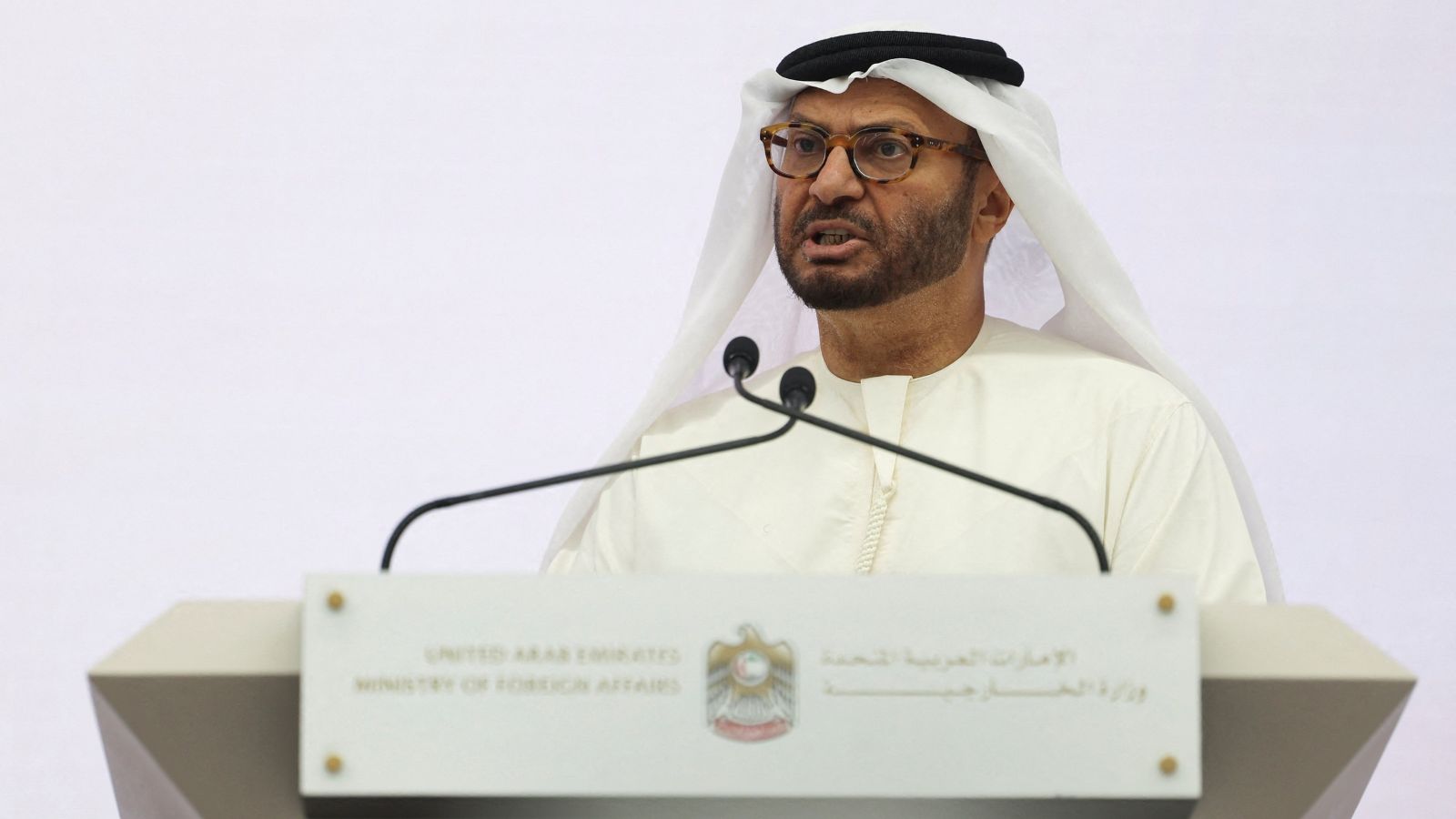
Anwar Gargash rarely speaks without a specific audience in mind. When the senior diplomatic advisor to the United Arab Emirates president warns of prolonged regional uncertainty and describes a US-Iran settlement as difficult to achieve, he is signaling a calculated shift in how Gulf capitals price geopolitical risk. A comprehensive diplomatic breakthrough between Washington and Tehran remains blocked by incompatible core demands over nuclear enrichment thresholds, regional proxy networks, and enforceable sanctions relief, forcing Gulf states to hedge against years of managed friction rather than a grand bargain.
Publicly, diplomatic communiques from the Gulf Cooperation Council emphasize de-escalation and dialogue. Privately, policymakers in Abu Dhabi and Riyadh have spent the better part of a decade auditing the gap between Western diplomatic rhetoric and on-the-ground security realities. Gargash’s blunt assessment strips away the wishful thinking that often surrounds backchannel talks in Oman or Qatar. It tells investors, energy markets, and regional militaries to prepare for an extended period of strategic ambiguity.
The Architecture of a Diplomatic Deadlock
To understand why a lasting US-Iran settlement remains out of reach, you have to look at the structural mismatch between what Washington can legally offer and what Tehran is politically willing to accept. Neither side operates in a vacuum. Both are constrained by domestic veto players who treat compromise as existential defeat.
In Washington, any executive agreement faces immediate institutional skepticism. Following the 2018 withdrawal from the Joint Comprehensive Plan of Action, Iranian negotiators learned a hard lesson about the durability of American commitments across election cycles. Tehran now demands ironclad economic guarantees that no sitting US president can constitutionally provide without Senate ratification—a threshold that remains politically impossible on Capitol Hill. Without verifiable, long-term access to the global financial system, Iranian hardliners see little reason to dismantle advanced centrifuge cascades or surrender high-enriched uranium stockpiles.
Conversely, American negotiators cannot sell a nuclear-only deal to Congress or regional allies if Iran’s ballistic missile program and regional partner network remain untouched. From the perspective of the Pentagon and the State Department, decoupling nuclear limits from regional security simply funds Tehran’s conventional reach across the Levant and the Red Sea.
The numbers tell the story clearly. Iran’s nuclear program has moved far beyond the technical baselines of 2015, shrinking breakout timelines from months to weeks while accumulating irreversible institutional knowledge. Simultaneously, the proliferation of low-cost drones and precision-guided munitions among allied militias has altered the deterrence equation across the Middle East. A diplomat cannot easily trade away a sanction regime when the underlying security threats have multiplied rather than shrunk.
Abu Dhabi’s Calculated Hedging Strategy
The UAE sits fewer than forty miles across the Persian Gulf from Iranian territory. Geography dictates policy. When Gargash warns of prolonged uncertainty, he is articulating the rationale behind the Emirates' dual-track foreign policy—a strategy built on simultaneous engagement and deterrence.
Over the past several years, Abu Dhabi re-established full diplomatic relations with Tehran, sent its national security advisor to meet Iranian leadership, and expanded bilateral trade through Dubai’s re-export hubs. That outreach was not born out of ideological alignment. It was an insurance policy. Following the 2019 tanker sabotage off Fujairah and the January 2022 missile and drone attacks on Abu Dhabi, Emirati planners concluded that relying solely on an external security umbrella left their economic infrastructure dangerously exposed.
Economic Insulation Over Ideological Alignment
Dubai and Abu Dhabi have built their global brand on stability, capital mobility, and logistics efficiency. Prolonged regional friction threatens every pillar of that model. Shipping insurance premiums in the Strait of Hormuz spike at the slightest hint of naval confrontation. Foreign direct investment hesitates when airspace closures become routine.
By maintaining open diplomatic channels with Tehran while deepening defense integration with Washington, the UAE attempts to insulate its domestic economy from external shocks. Gargash’s public pessimism serves a dual purpose here. First, it manages expectations among international businesses operating in the Gulf, reminding them that regional stability is actively managed rather than guaranteed. Second, it signals to Washington that Gulf partners will continue pursuing independent bilateral de-escalation tracks with Iran regardless of how stalled US-Iran talks become.
The Myth of the Grand Bargain
Veteran observers of Middle East diplomacy recognize a recurring cycle. Every few years, speculation mounts around a comprehensive diplomatic reset—a single sweeping agreement that resolves the nuclear file, stabilizes maritime trade lanes, and normalizes regional relations. Gargash’s remarks puncture that illusion.
Grand bargains require mutual trust or overwhelming asymmetric leverage. Neither exists today. Instead, what passes for diplomacy between Washington and Tehran usually amounts to crisis management and informal understandings.
Consider how these quiet arrangements actually function in practice. Rather than signing formal treaties, intermediaries pass messages establishing unwritten red lines. One side agrees to slow the pace of uranium accumulation or restrain attacks on specific military bases; the other eases enforcement on certain oil exports or unfreezes restricted humanitarian funds. These micro-deals prevent full-scale regional war, yet they do nothing to resolve the underlying conflict.
Why Managed Friction Persists
Managed friction survives because it offers short-term utility to key actors, even as it breeds long-term instability.
- For Tehran: It preserves nuclear leverage as an ultimate deterrent while generating enough oil revenue to keep the domestic economy afloat under sanctions pressure.
- For Washington: It contains escalation during sensitive domestic political periods without requiring the political capital needed to push a major treaty through Congress.
- For Gulf States: It buys time to diversify economies away from hydrocarbons and build sovereign defense manufacturing capabilities.
Yet this equilibrium is inherently fragile. Informal understandings lack verification mechanisms and dispute-resolution panels. A single miscalculation by a local militia commander, an unattributed cyberattack on critical infrastructure, or an intercepted arms shipment can collapse months of quiet backchannel work overnight.
What Prolonged Uncertainty Means for Global Markets and Security
When a senior Emirati official publicly forecasts an extended period of instability, the consequences ripple far beyond diplomatic salons in Geneva or Muscat. Energy traders, sovereign wealth funds, and defense planners read those statements as operational guidance.
Energy Chokepoints and Supply Chain Resilience
Roughly a fifth of the world’s petroleum liquids pass through the Strait of Hormuz. Even when physical oil flows remain uninterrupted, persistent geopolitical friction imposes a hidden tax on global commerce. Tanker operators alter routing schedules, maritime security contractors expand operations, and Asian refiners diversify crude sourcing to mitigate sudden supply disruptions.
Gulf producers have spent billions building overland pipelines—such as the Habshan-Fujairah pipeline in the UAE and Saudi Arabia’s East-West pipeline—specifically to bypass the Strait of Hormuz in a crisis. Those infrastructure investments reflect a permanent assumption in Gulf capitals: the maritime chokepoint will remain contested indefinitely.
The Shift Toward Autonomous Deterrence
At the same time, uncertainty over a US-Iran settlement accelerates military modernization across the Arabian Peninsula. For decades, Gulf states purchased high-end Western hardware largely to cement political alliances with Washington. Today, acquisition priorities focus on integrated air and missile defense, counter-drone systems, and domestic defense production.
The UAE’s defense conglomerate, EDGE Group, exemplifies this transition. Rather than waiting indefinitely for foreign export approvals on sensitive technologies, Abu Dhabi has poured capital into sovereign drone manufacturing, electronic warfare systems, and precision munitions. If diplomatic settlements remain elusive, regional states intend to ensure they possess the organic capability to defend their airspace and critical desalination plants independently.
The Counter-Argument What Could Force a Breakthrough
Dismissing the possibility of a US-Iran settlement entirely ignores the history of sudden diplomatic pivots in the Middle East. Skeptics of Gargash’s outlook point out that prolonged economic attrition inside Iran or a severe geopolitical shock could alter Tehran’s calculus faster than analysts expect.
Iran faces compounding domestic pressures: persistent inflation, currency depreciation, aging energy infrastructure, and recurring social unrest. Should economic strain reach a point where regime survival overrides ideological resistance, Tehran could abruptly empower negotiators to accept deeper nuclear restrictions in exchange for immediate sanctions relief.
Similarly, a major shift in great-power dynamics—such as coordinated diplomatic pressure from Beijing, which buys the vast majority of Iran’s discounted crude exports—could introduce new leverage into stalled negotiations. China relies heavily on Gulf stability for its own energy security and has demonstrated a willingness to broker regional agreements when its commercial interests are directly threatened, as seen in the 2023 Saudi-Iranian diplomatic restoration.
Still, betting on sudden diplomatic conversion is a poor strategy for policymakers responsible for national security. Gargash’s warning reflects a sober consensus in Abu Dhabi: hope is not a policy, and until structural incentives change in both Washington and Tehran, the Middle East must govern itself around permanent uncertainty.