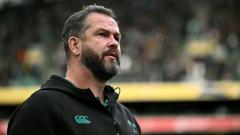
The rugby media is currently drowning in a collective sigh of relief, celebrating the Irish Rugby Football Union securing Andy Farrell until 2031 as a masterstroke of administrative genius. They call it stability. They call it a statement of intent. They are completely wrong.
By locking down a head coach for a staggering seven-year term, the IRFU did not secure its future. It paralyzed it.
Long-term contracts in elite professional sports are almost always an act of organizational cowardice disguised as vision. They are signed by executives who are terrified of change, desperate to preserve a status quo that feels comfortable right now, oblivious to the fact that high-performance environments stagnate the moment comfort sets in.
International rugby does not operate on corporate fiscal timelines. It operates on brutal, unforgiving four-year World Cup cycles. Handing out a contract that spans nearly two full cycles is a structural gamble that ignores the historical reality of how elite teams actually decay.
The Myth of the Eternal Cycle
The lazy consensus dominating the back pages is simple: Farrell is a world-class operator, Ireland is winning, therefore more Farrell equals more winning. It is a linear delusion.
High-performance coaching has a shelf life. Elite human beings, no matter how charismatic or tactically astute, eventually suffer from message fatigue. Players, even the most dedicated professionals, subconsciously tune out the same voice after a half-decade of exposure.
Look at the historical precedents across the sport.
Sir Clive Woodward built the greatest England team in history, peaking in 2003. By 2004, the environment had grown stale, the patterns predictable, and his departure was a messy, overdue realization that the cycle had ended.
Sir Steve Hansen managed to sustain the All Blacks across two cycles, but even that legendary run ended in the semi-final heartbreak of 2019 when a hungry, tactically fresh England team blew them off the park. The margins at the absolute top are minuscule, and nothing erodes those margins faster than familiarity.
By 2031, Andy Farrell will have been in the Irish setup for fifteen years, twelve of them as head coach. Show me a single modern international rugby coaching regime that maintained a world-number-one trajectory for over a decade without suffering a catastrophic dip. It does not exist.
The Seven-Year Financial Chokehold
Let us talk about the brutal reality of the balance sheet. Professional rugby is facing a precarious financial climate. While the IRFU operates a highly successful centralized model, it is not immune to economic gravity.
When you sign a head coach to a seven-year deal, you are committing a massive, non-negotiable portion of your high-performance budget to a single line item. If the wheels come off in 2027—if Ireland suffers another devastating quarter-final exit or a sudden squad mutiny—the buyout clause required to terminate a contract with four years left on it would be fiscally crippling.
This creates an incredibly dangerous incentive structure. It makes the head coach unfireable.
When a coaching staff knows they cannot be removed without bankrupting the union, a subtle shift occurs. The urgency evaporates. The radical experimentation required to stay ahead of innovators in South Africa, France, and New Zealand gets replaced by safe, incremental maintenance.
Imagine a scenario where a mid-cycle slump occurs in 2028. Instead of having the administrative agility to pivot, restructure, or bring in a fresh voice, the IRFU will be forced to double down on a failing regime simply because they cannot afford the divorce settlement. That isn’t strategic planning. It is financial self-sabotage.
Suffocating the Coaching Pipeline
The true damage of this seven-year decree will not be felt at the Aviva Stadium this weekend. It will be felt in the coaching rooms of Leinster, Munster, and Ulster.
Ireland’s success over the past fifteen years is built entirely on its tightly integrated ecosystem. The provincial pipeline produces the talent; the national team reaps the rewards. But that pipeline requires upward mobility, not just for players, but for coaches.
What happens to the ambitious, world-class tactical minds currently developing within the Irish system?
Coaches like Simon Easterby, Paul O'Connell, or the brightest minds running the provincial setups now look at the national hot seat and see a "No Vacancy" sign hung up until the next decade. Top-tier coaching talent will not sit around twiddling their thumbs for seven years playing the loyal assistant. They will leave.
They will take jobs in the Premiership, the Top 14, or with rival international unions. The IRFU is effectively exporting its intellectual property to preserve one man’s comfort zone. By the time 2031 rolls around, Ireland risks finding its domestic coaching pipeline completely drained of elite, ready-made successors.
The Wrong Question About World Cup Success
Whenever critics point out Ireland's historical inability to progress past the quarter-finals of a World Cup, the standard response from the rugby establishment is: "How do we fix the system to ensure continuity?"
This is entirely the wrong question. Continuity is the problem, not the solution.
World Cups are not won by teams that have been running the exact same system for six years. They are won by teams peaking at the exact right moment, often fueled by tactical reinvention or a desperate, chaotic hunger. South Africa won back-to-back Webb Ellis trophies not through serene stability, but through radical, high-stakes shifts—bringing in Rassie Erasmus, weaponizing the "Bomb Squad," and completely rewriting defensive paradigms on the fly.
Ireland’s current system is magnificent at winning Six Nations titles and dominating autumn internationals because it functions like a finely tuned clockwork machine. But clockwork is predictable. In a knockout tournament, predictability is death.
By locking in Farrell until 2031, the IRFU has signaled that it values the high-floor security of consistent Six Nations performances over the high-ceiling volatility required to actually conquer the world stage. It is an admission that they prefer the safety of the top three in the world rankings over the risky, uncomfortable evolution needed to be number one when it actually matters.
The Hard Truth of High Performance
This is not an indictment of Andy Farrell's capability. He is an exceptional leader who has delivered some of the greatest days in Irish rugby history. But elite sport is ruthless, and the moment an organization stops being ruthless, it begins its decline.
The downsides of a short-term, cycle-by-cycle approach are obvious: it creates anxiety, it requires constant renegotiation, and it forces executives to make difficult decisions every four years. But that friction is precisely what keeps a high-performance environment sharp. Friction prevents complacency.
The IRFU chose to eliminate friction. In doing so, they have created an environment where the head coach has more institutional job security than the politicians running the country.
If Farrell defies human nature, economic reality, and sports history to keep Ireland at the absolute pinnacle of the global game for the next seven years without a single period of stagnation, it will be the greatest administrative triumph in modern sports history.
But history screams that won't happen. Long before 2031, this historic contract will look less like a monument to stability and more like a gilded cage of the IRFU’s own making.
Stop celebrating the contract. Start worrying about the stagnation.


