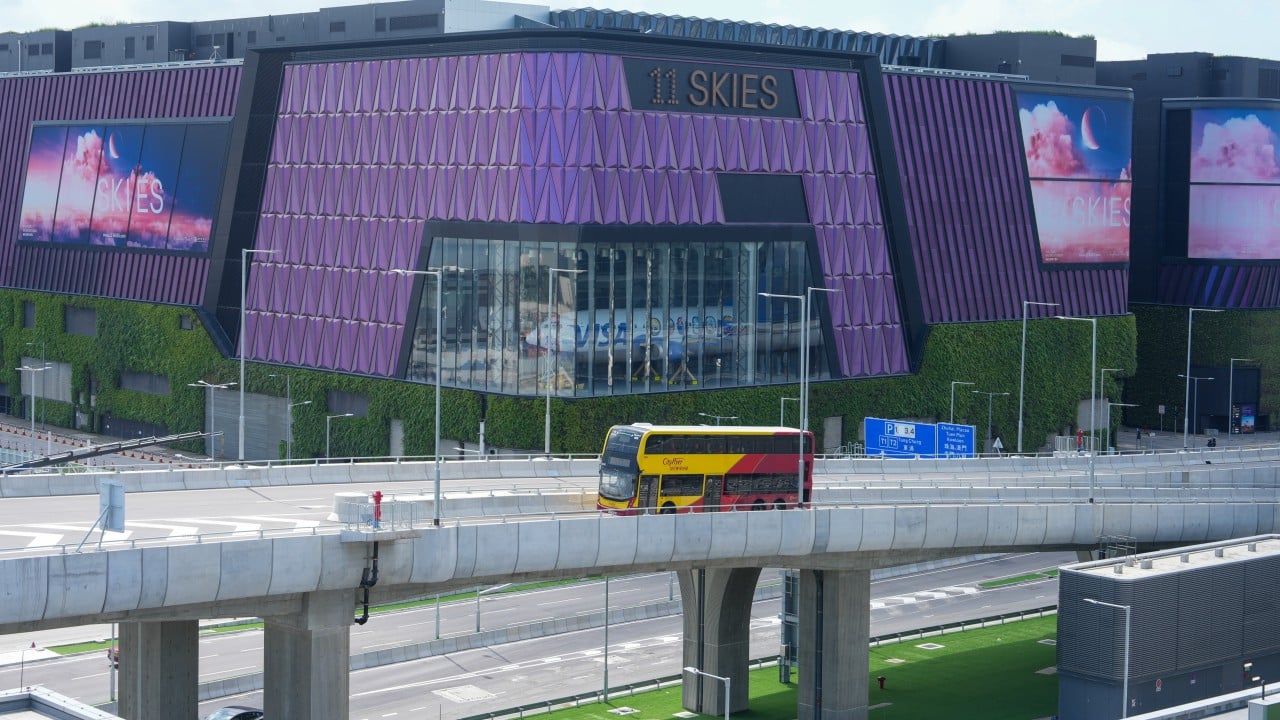
The concrete is too clean. That is the first thing that strikes you when you walk out of the arrivals terminal at Hong Kong International Airport and head toward the massive, undulating glass facade rising out of the reclaimed land of Chek Lap Kok. Usually, mega-projects in this city smell of diesel, sweat, and the sharp, metallic tang of constant welding. But here, the air is quiet. The glass panels reflect a gray sky, pristine and undisturbed.
For the last three years, the headlines have been brutal. Analysts looked at the delayed openings, the quiet corridors, and the shifting timelines of 11 Skies—the massive $2.6 billion retail and entertainment complex spearheading Hong Kong’s SkyCity development—and pronounced it dead on arrival. They called it a monument to bad timing. A retail dinosaur born into an era where mainland tourists prefer buying luxury bags via livestream from their apartments in Shenzhen rather than flying across the water to queue in a physical store.
They are wrong. They are wrong because they are looking at 11 Skies through the lens of 1995, evaluating it as a shopping mall.
It is not a mall. It was never meant to be a mall. To understand what is actually happening behind that glass facade, you have to look past the empty storefronts and look at the changing geometry of how human beings move across borders.
Consider a traveler named Lin. She is hypothetical, but her itinerary is precisely what the architects of this concrete giant spent billions to capture. Lin lives in Dongguan, a manufacturing hub in the Greater Bay Area. She needs to see a wealth manager to structure her family’s cross-border investments, and she needs to take her daughter to a specialized pediatric clinic for a consultation that isn’t easily available in her hometown.
A decade ago, Lin’s journey would have involved a grueling multi-stage trek: a train to Shenzhen, a bureaucratic border crossing, a crowded subway ride into Central Hong Kong, a night at an expensive hotel, and a reversed itinerary the next day. It was an exercise in friction.
Today, Lin gets into a dual-plate vehicle. She drives across the Hong Kong-Zhuhai-Macao Bridge. She parks at a dedicated automated parking lot next to the airport without ever technically passing through Hong Kong immigration. She walks into a climate-controlled tower. By noon, her wealth management meeting is done, her daughter’s medical appointment is finished, and they are watching an immersive digital art show in the entertainment wing. By dinner, they are back in Dongguan.
Hong Kong did not spend billions to build another place to buy Gucci loafers. They built a massive, physical integration valve for an urban cluster of 86 million people.
The real pivot of 11 Skies is found in its three office towers, which quietly opened while the retail sections remained under wraps. They aren't occupied by fashion brands or souvenir shops. The anchor tenants are major financial institutions, wealth management firms, and massive medical networks like KMPG and Trinity Health Enterprise.
Think about the psychological shift that represents. Historically, Hong Kong’s economic engine was tied to its geography. Central was the fortress of finance; Tsim Sha Tsui was the playground of retail. You went to different neighborhoods for different needs.
But the creation of the Greater Bay Area—linking nine mainland cities with Hong Kong and Macao—rewrote the map. The geographic center of gravity shifted away from Hong Kong Island and landed squarely on a patch of reclaimed land in the sea.
The strategy is clear when you examine the numbers. The complex spans over 3.8 million square feet. But instead of the traditional 70-30 split favoring retail that defined older mega-malls, 11 Skies reallocates massive footprints to professional services and experiential entertainment. It is designed to capture the "wealth and wellness" market of a rapidly aging, increasingly affluent southern Chinese middle class. They do not want more stuff. They want expertise. They want security. They want health.
The skepticism surrounding the project is understandable. Anyone who walked through the area over the past few years would have felt a sense of eerie isolation. The pandemic slammed the borders shut just as the concrete was drying. Then came the structural shift in Chinese consumer behavior. The old playbook—where mainlanders arrived with empty suitcases and left with them stuffed full of cosmetics and watches—is broke. It isn't coming back.
If 11 Skies were just a shopping center, this would be a catastrophic, terminal failure. But look at the infrastructure anchoring it. It sits adjacent to the airport's Third Runway System, which expands passenger capacity exponentially. It connects directly to the Hong Kong-Zhuhai-Macao Bridge via the "Airportcity Link" bus network.
The complex is acting as a giant, physical buffer zone. It allows residents from the mainland to access Hong Kong's highly trusted legal, financial, and medical ecosystems without adding strain to the city's internal transportation and housing infrastructure. It is a border town built for the twenty-first century, operating at supersonic speeds.
The transition from a manufacturing-based economy to a high-value service hub is messy. It looks like empty corridors. It looks like delayed grand openings. It looks like a gamble that keeps CFOs awake at night.
But walk back out to the edge of the complex and watch the bridge in the distance. The cars keep coming. The automated parking structures are filling up, row by row, vehicle by vehicle. The true story of this place isn't about retail sales per square foot or whether a luxury brand decides to open a flagship store next month.
It is about the invisible lines connecting eighty-six million people, drawing them toward a single point of convergence. The glass towers aren't empty because the project failed. They are waiting for the rest of the world to catch up to the scale of the map they've drawn.