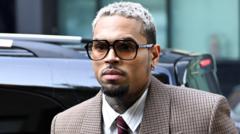
The media wants you to look at the $13.1 million settlement Chris Brown was ordered to pay his former housekeeper and feel a sense of clean, judicial closure. They want you to think justice was served because a wealthy celebrity was held accountable after his Caucasian Shepherd, Hades, severely injured a worker on his property.
They are wrong. You might also find this related story interesting: The Five Million Dollar Wedding Security Myth Why Celebs Waste Millions on Threat Theater.
The coverage of this massive payout misses the structural rot beneath celebrity asset protection and the illusion of high-liability insurance. Everyone is focusing on the eye-popping dollar amount. Nobody is talking about how the current legal and insurance framework actually incentivizes ultra-wealthy individuals to neglect basic safety protocols until a catastrophe occurs. This is not a story about a dog bite. This is a story about the complete failure of the private liability ecosystem.
The Illusion of Financial Accountability
When a headline reads "Celebrity Ordered to Pay Millions," the public assumes a check is written, a bank account shrinks, and lessons are learned. In reality, these mega-settlements rarely function as direct financial punishments for the ultra-wealthy. Instead, they expose a highly commoditized risk-shifting apparatus that protects the negligent while offering delayed, often hollow restitution to victims. As highlighted in recent reports by Associated Press, the results are widespread.
Let’s dismantle the mechanics of high-net-worth liability.
An individual of Chris Brown’s financial stature does not operate out of a personal checking account. Assets are shielded behind layered corporate structures, LLCs, and comprehensive umbrella insurance policies. When a horrific incident like the 2020 dog attack occurs, the ensuing legal battle is not between a victim and a celebrity; it is a war of attrition between a victim's legal counsel and a multi-billion-dollar insurance carrier’s defense apparatus.
The $13.1 million figure is a risk-calculated compromise. Insurance companies do not settle for eight figures out of a sense of moral obligation. They do it because their actuarial tables indicate that a jury trial in Los Angeles County, given the horrific nature of the injuries—which included chunks of flesh torn from the victim's arm and face—could easily yield a punitive damage award twice that size.
By settling, the system covers its own track. The insurance company caps its loss, the celebrity avoids a public trial that could destroy future touring revenue, and the fundamental issue—the ownership of apex predators by individuals incapable of managing them—remains entirely unaddressed.
The Fallacy of the Dangerous Breed Narrative
The lazy consensus in the court of public opinion always reverts to a predictable debate about dangerous dog breeds. Outraged commentators call for bans on Caucasian Shepherds, pit bulls, or rottweilers. This entirely misses the mark.
The breed is not the variable; the environment of unearned privilege is.
A Caucasian Shepherd, or Ovcharka, is a livestock guardian bred to fight off apex predators like wolves and bears in the Caucasus mountains. They possess an immense prey drive and an instinctual territorial defense mechanism. They are working dogs, not backyard ornaments for pop stars.
[Dog Breed Risk Factors]
Livestock Guardian Instincts + High-Stress Urban Environment + Zero Professional Handling = Catastrophic Liability
When you place a dog requiring rigorous, professional-grade handling into a chaotic, high-stress estate environment with a constant rotation of staff, guests, and sycophants, you are not owning a pet. You are staging a localized public safety crisis.
The liability does not rest on the animal’s genetics; it rests on the owner’s hubris. Yet, our current legal framework treats these incidents as freak accidents rather than predictable outcomes of systemic negligence. If you store an unsecured commercial explosive on your lawn and it detonates, injuring an employee, you face criminal prosecution. If your 150-pound guard dog mutilates an employee, it is treated as a civil tort handled by insurance adjusters.
Why Umbrella Insurance Invites Negligence
Insurance is meant to mitigate risk, but in the realm of high-net-worth individuals, it frequently creates a moral hazard. A moral hazard occurs when someone is insulated from the financial consequences of their actions, making them more likely to take unnecessary risks.
Consider the standard underwriting process for high-limit umbrella policies. Carriers ask about swimming pools, trampolines, and yes, dog breeds. But once the policy is issued, there are no surprise inspections. There is no active monitoring of whether a celebrity's entourage is leaving gates open or if a historically aggressive animal is being kept around domestic staff.
I have seen high-net-worth individuals treat insurance premiums as a license to bypass basic human decency and safety protocols. They operate under the assumption that if something goes sideways, the insurance company will throw money at the problem until it disappears.
This settlement proves that theory correct. The system functioned exactly as designed. The victim suffered life-altering physical and psychological trauma, the legal teams extracted massive fees, the insurance company absorbed a calculated hit, and the celebrity's lifestyle continues largely unhindered.
Dismantling the Premium Defense
Defenders of the status quo argue that the high premiums paid by wealthy individuals justify the existence of this safety net. They argue that without these massive policies, victims would have no guaranteed avenue for financial recovery, especially if an asset-light celebrity faces bankruptcy.
This argument is a trap. It prioritizes the financial mop-up operation over the prevention of human suffering.
If the legal system truly wanted to deter this behavior, liability wouldn't stop at financial restitution covered by a corporate policy. True deterrence requires piercing the corporate veil and enforcing strict criminal liability for owners whose animals cause severe bodily harm while under negligent supervision.
Instead, we tolerate a double standard. If a working-class individual's dog attacks a neighbor, the animal is seized immediately, and the owner often faces reckless endangerment charges because they lack the resources to drag the case out in civil court for four years. When it happens on a Tarzana estate, it becomes a multi-year chess match of depositions, medical examinations, and corporate hand-wringing.
Stop Asking if the Payout is Fair
The public discussion surrounding this case constantly revolves around one flawed question: "Is $13 million enough?"
You are asking the wrong question. You are looking at the scoreboard instead of the game.
The real question we should be asking is why our legal architecture allows individuals with documented histories of volatile behavior to acquire and maintain living weapons without continuous, independent verification of safety standards.
An eight-figure settlement is not a victory for accountability; it is a glaring indictment of a society that allows wealth to subsidize existential risks to everyday workers. The housekeeper didn't win a lottery. She lost her physical integrity, her livelihood, and her peace of mind because an elite safety ecosystem failed her long before the first bite occurred.
Stop viewing these high-profile judgments as moments of triumph over celebrity recklessness. They are corporate write-offs wrapped in a narrative of justice. Until the legal consequence of extreme negligence shifts from an insurance company's balance sheet to the personal freedom of the owner, the estates will remain dangerous, the staff will remain vulnerable, and the checks will keep being written.