The phone rings in a quiet home in Karachi, and for a fraction of a second, the universe holds its breath. It is the call every aviation family fears. The one that arrives not with answers, but with a terrifying absence of them.
On Tuesday evening, First Officer Faisal Jatoi did what he always did before a flight. He called his wife from Sharjah in the United Arab Emirates. He told her he was coming home. The routine of the merchant flight crew is built on these small, predictable anchors. You fly out, you secure the cargo, you check the dials, and you call home before the wheels leave the tarmac. It is a contract written in the sky. Learn more on a similar subject: this related article.
But contracts break.
Somewhere over the black expanse of the Arabian Sea, at 9:21 p.m., that predictability dissolved into chaos. Within minutes, a routine cargo flight transformed into a frantic race against the ocean, leaving five families stranded in the excruciating purgatory of the unknown. Further journalism by NPR highlights comparable perspectives on the subject.
The Ghost in the Instrument Panel
To understand what happened to K2 Airways flight KTA1732, you have to understand the sheer loneliness of a cockpit over the ocean at night. When you fly over the sea, the horizon vanishes. The sky and the water merge into a single, ink-black void. You are entirely dependent on the glowing green and amber numbers on your instrument panel to tell you which way is up.
Then, the numbers lie.
Captain Muhammad Rizwan Idris and his crew reported a navigational system malfunction just as they were beginning their approach toward Karachi. In aviation, a navigation failure is not a simple matter of losing your map. It is the sudden onset of blindness.
What followed next, preserved in the cold memory of radar logs, reads like a violent struggle for control. The Boeing 737 freighter did not simply glide into the water. It fought. Data shows a sudden, sharp change in heading. Then, a terrifyingly rapid plunge. In the dark, the crew must have felt the sickening pull of gravity as the aircraft dropped through the air.
Then came the rebound. The plane climbed again, a desperate, muscular effort by the pilots to yank the aircraft back from the mouth of the sea.
It was not enough. A second, final plunge cut through the night. The radar screens at Karachi Area Control Centre blinked. The green dot representing five living men and tons of cargo vanished.
The Sound of the Monsoon
When an airplane falls from the sky, the world on the ground moves with terrifying speed, yet feels agonizingly slow to those waiting for news. Within hours, the Pakistan Navy frigate PNS Zulfiqar was cutting through the swells, joined by maritime security vessels, Air Force planes, and commercial merchant ships that turned their hulls toward the last known coordinates.
For twelve hours, searchers scanned the water. The Arabian Sea in July is not a calm, glassy mirror. It is the season of the monsoon. The waves are high, choppy, and relentless. The wind whips the spray into a blinding mist.
Imagine standing on the deck of a naval vessel in the dead of night, looking into a pitch-black ocean that refuses to give up its secrets. Ocean currents are thieves; they take debris and scatter it across miles of open water, teasing rescuers with fragments while hiding the truth deep below.
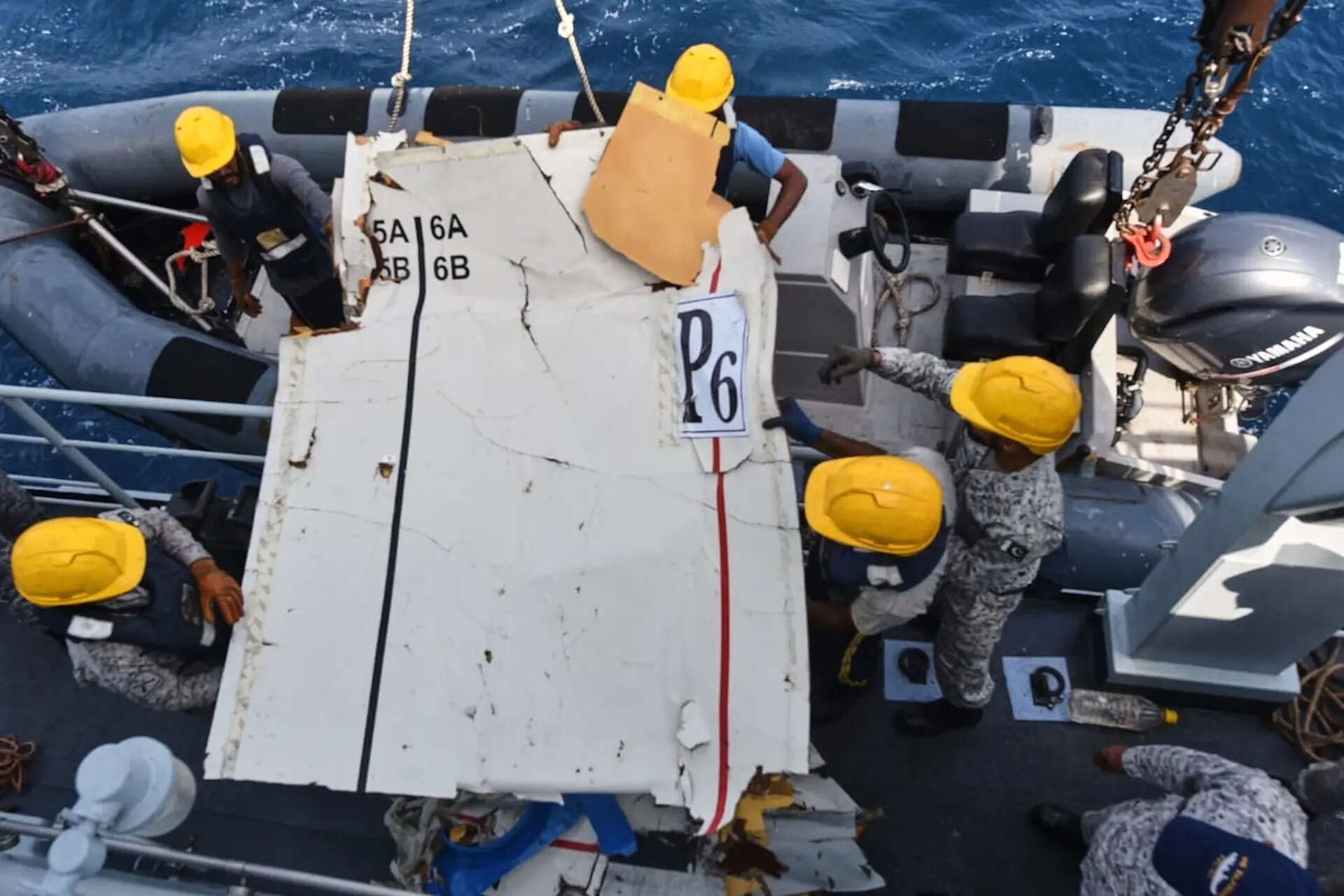
By Wednesday morning, the sea yielded its first grim confirmations. Pieces of twisted metal, painted in the distinct red and white livery of K2 Airways, were hauled over the gunwales of naval boats. The logo—symbols of a company built on the pride of flight—lay flat on the damp wooden decks of rescue ships. The wreckage was pulled from the water roughly 53 nautical miles south of the coastal town of Ormara.
But finding the metal is the easy part. The real challenge lies beneath.
The main body of the aircraft is believed to have settled into a trench nearly 3,000 meters deep. That is nearly two miles of crushing, freezing water. At that depth, the ocean is as dark as the night sky the plane fell from. Recovering the flight data recorders from that abyss will require specialized deep-sea equipment, a task that retired Rear Admiral Faisal Shah noted would test the absolute limits of the recovery teams.
Five Names in the Dark
In the clinical language of aviation authorities, the occupants of the plane are listed as "the crew." But to the people waiting on the shores of Karachi, they are everything.
There is Captain Idris, the man holding the ultimate responsibility for the vessel. There is Faisal Jatoi, the young co-pilot whose wife still looks at her phone, waiting for a ringtone that may never come. There are the flight engineers, Muhammad Hamid and Muhammad Arif Siddiqui, the mechanical minds who spend their lives ensuring that thousands of pounds of steel remain miraculously buoyant in the air. And there is Muhammad Taufiq Khan, the aircraft loader, the man who secured the freight before the doors were sealed in Sharjah.
"All we can do is wait and pray for a miracle," said Ghulam Nabi Bahrani, Jatoi’s father-in-law. His voice carries the heavy, exhausted cadence of a man who has run out of tears but refuses to run out of hope.
The human mind is poorly wired for ambiguity. We can mourn a tragedy, and we can celebrate a rescue, but existing in the space between those two realities is a unique kind of torture. The families are trapped in that space right now. Prime Minister Shehbaz Sharif has promised that every available resource will be thrown into the ocean to find them, but the ocean is massive, and it does not care about promises.
The Long Shadow over Karachi
This coast has felt this pain before. For the people of Karachi, the disappearance of the cargo flight triggers a collective shudder of memory. It was only six years ago, in May of 2020, when a Pakistan International Airlines flight lost power and plunged directly into a crowded residential neighborhood just short of the Karachi runway. Ninety-eight lives ended in an instant, leaving a scar on the city’s skyline and its psyche. That disaster was later attributed to a cascading sequence of human errors.
Now, the city looks to the sea instead of the streets.
Aviation experts like Imran Aslam are already puzzling over the radar tracks. Planes do not usually fall out of the sky simply because an engine fails or a navigation screen goes dark. Modern aircraft are aerodynamic gliders; even with total power loss, they can coast for miles, giving a skilled crew time to find a strip of land or execute a controlled ditching.
The violent oscillations of flight KTA1732—the plunge, the frantic climb, the final drop—suggest something far more catastrophic occurred in the dark. Was it a sudden structural failure? Did a shift in the cargo unbalance the aircraft beyond the point of control? Or did the navigational failure blind the pilots so completely that they could no longer distinguish up from down?
The answers are locked inside the black boxes, resting in the silent silt two miles beneath the waves of the Arabian Sea.
Until those boxes are found, the searchlights will continue to cut through the monsoon mist. The ships will circle the coordinates south of Ormara, their crews staring into the gray water, looking for signs of life among the floating fragments of aluminum and insulation.
And in Karachi, five families will keep their lamps burning through the night, listening to the distant roar of the surf, waiting for the miracle that the sea so rarely grants.